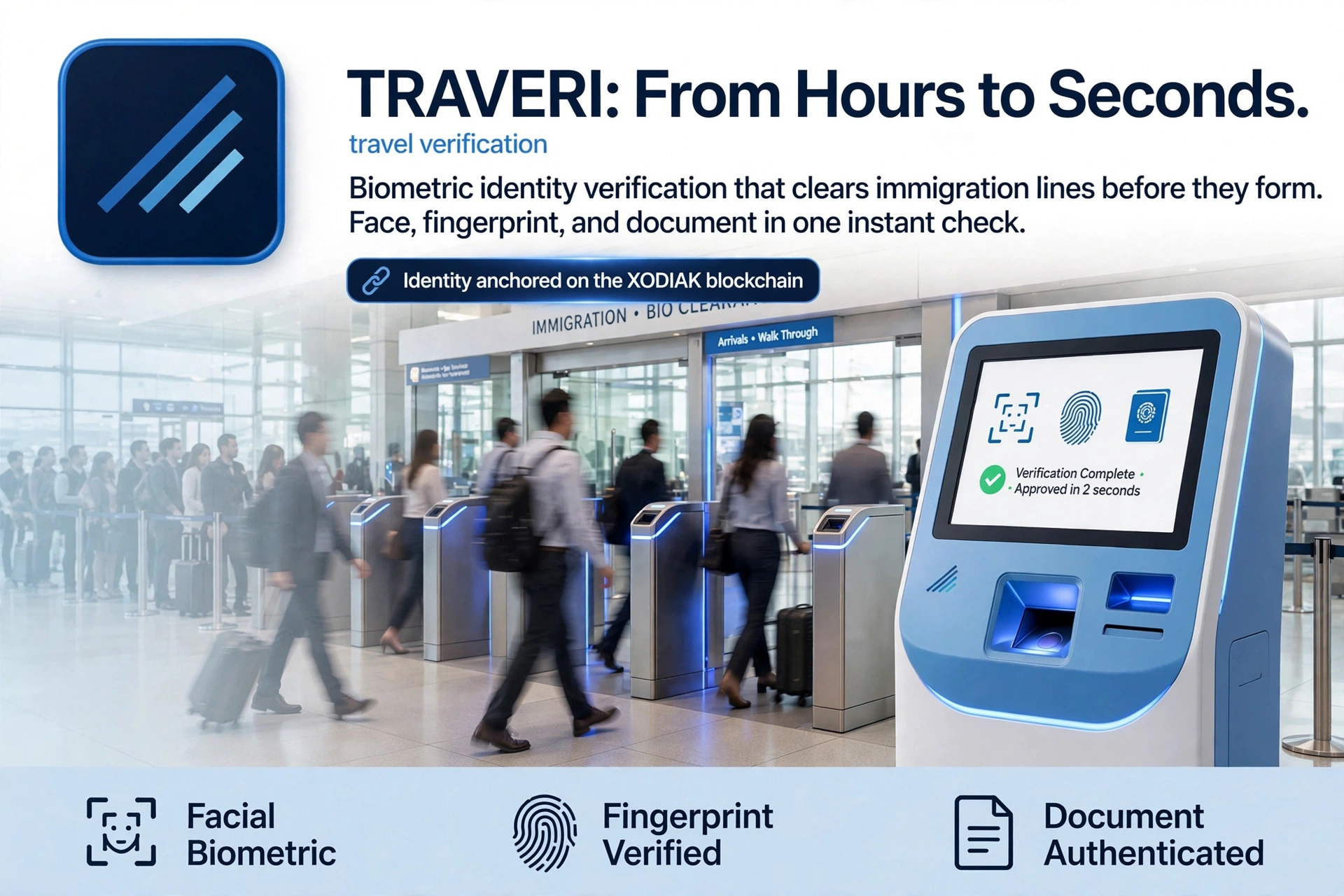
Vietnam's biometric lanes serve its citizens. India's serve Indians. The foreign arrivals in the hall, 15.9 million of them this year, stand in the manual line. TRAVERI is the system built for them.
The split, in the open. Our security reviewers set this standard: a name only goes on what survives diligence.
An integration, not an invention claim. Every module is a component class you can buy today. Our work is the architecture, the integration, and the operation.
Tap any module on the plate. Each one is a standard component class with certified vendor options, the same discipline as the ROSE panel BOM: formal quotes at prototype procurement, nothing invented, nothing bespoke where a proven part exists.
| Reading note | Prices in this panel are budgetary planning ranges, pending vendor quotes. |
| Status | Designed. Not built, not deployed. |
Three paths through the hall. The third one matters as much as the first two: nobody is forced into biometrics, ever.
Pick a path. The third traveler is the promise this system is judged by.
Before the flight. Passport scanned in the app, chip read over NFC, selfie taken once. A FIDO2 passkey binds the credential to the phone. The Digital Arrival Card completes in the same flow.
At the gate. Face matches the enrollment selfie and the passport chip photo, with liveness. Templates are compared, then deleted.
Through. The e-gate opens. An officer sees the cleared event on screen, with an audit trail behind it.
Recorded as a hash. XODIAK stores the attestation bundle hash and the verdict. No face, no fingerprint, no passport image ever touches the ledger.
Lands unenrolled. Signs in the hall and staff point to the kiosk row. Nothing was required before the trip.
At the kiosk. Passport into the reader, chip verified, camera captures face and one fingerprint with liveness, in the traveler's language.
Consent, plainly. What is stored, where, and for how long, stated before a thumb is offered. Declining routes to the manual lane with no penalty and no second pitch.
Same gate. Cleared at the e-gate on this trip, and enrolled for the next one.
No app, no kiosk, no account. The traveler walks past the fast lane to the staffed booths, exactly as today.
An officer does the whole check by hand, document and questions, the current process unchanged.
Nothing biometric is captured. No template exists because none was created. There is nothing to delete and nothing to leak.
The lanes stay staffed. The pilot funds the manual lane alongside the fast lane. The choice is permanent, not a launch gimmick.
Every country that built biometric lanes built them for its own citizens first. The foreigner lane is open everywhere, and it is the harder, more valuable build.
Biometric lanes at Tan Son Nhat, Da Nang, and Noi Bai authenticate against the national citizen database. Foreigners have no record in it, so they are processed manually, while arrivals climb past 15.9 million in eight months.
DigiYatra and DigiLocker were built citizens-first on Aadhaar. Foreigners were added years later through on-arrival kiosk enrollment, with biometric data deleted after 24 hours and re-enrollment on every trip. It works, and it shows the cost of not designing for foreigners from the start.
Decision 1830/QD-TTg, September 2026, opened formal cross-border identity pilots, first with Singapore and Laos. TRAVERI is designed for exactly this frame: a persistent, consent-based credential for foreign travelers, run on Vietnam's terms, with biometrics processed in country.
Tap a layer. Most of this exists today inside the Biz Dev App platform. The pilot is wiring, not invention.
Nothing reaches an airport until each gate passes, in order. This matrix is also the pilot's quality plan and the diligence file, in one table.
| Gate | What it proves | Status |
|---|---|---|
| FIDO2 / WebAuthn | Phishing resistant passkeys bind enrollment to the traveler's device. The design standard our security reviewers require as the foundation. | Designed in |
| FIDO Certification | The implementation itself, certified, before anything biometric ships. | Gate at prototype |
| ICAO Doc 9303 | Passport chips read and verified to the global eMRTD standard. | Designed in |
| ISO/IEC 30107-3 + iBeta 1 and 2 | Liveness and anti-spoof, proven by an accredited lab. Includes photo, video, mask, and identical twin attempts. | Gate at prototype |
| NIST FRVT | Face matching on an algorithm with published, audited accuracy. | Vendor criterion |
| SOC 2 Type II + ISO/IEC 27001 | Operating controls audited over time, before production data arrives. | Gate at pilot |
| Vietnam PDPL | Data residency, consent, and deletion rules under Vietnamese law, the frame the whole design obeys. | Designed in |
| Independent penetration test | External testers attack the full stack: kiosk, app, edge, ledger. Findings closed before the pilot. | Gate at pilot |
| Client reference list | The references a government asks for first. Ours is honest and short: live platforms, zero border deployments, stated on its first line. | Drafted, verifiable |
Budgetary ranges from component class pricing, for planning. Formal vendor quotes land at prototype procurement.
| Per lane | Class | Estimate |
|---|---|---|
| Passport document reader | Full page, RFID, Thales / IDEMIA / HID class | $2,800 to $4,500 |
| Face camera with depth | Dual lens + IR depth module | $900 to $2,200 |
| Fingerprint scanner | FBI Appendix F class, HID / Suprema | $650 to $1,400 |
| Traveler display | 21.5 in PCAP touch + bezel | $1,100 to $1,900 |
| Edge compute module | Jetson Orin class | $800 to $1,600 |
| E-gate mechanism | Dual swing barrier, OEM | $9,000 to $16,000 |
| Enclosure and power | Kiosk body, UPS, receipt printer | $3,400 to $5,600 |
| Hardware per lane | $22,000 to $38,000 |
One working kiosk and one gate. iBeta pre-assessment, FIDO design review, the twin test run for real.
Six lanes at Tan Son Nhat, sovereign edge stack, SOC 2 and ISO 27001 audits, penetration test, 12 months of operation.
Five airports, integration with national systems, regional support team.
All figures are budgetary estimates in USD, pending formal vendor quotes and ministry scope.
The arrangement our security reviewers approved, stated the way they approved it.
That sentence is the whole public claim, and it is true. The bench behind it: specialists whose shipped work includes widely used authentication technology and national scale security programs, with penetration testing run at a level that beat major platform vendors in head to head evaluation.
They are engaged under a discipline they set: diligence first, penetration testing before production, no names attached until the work survives both. When the pilot reaches that gate, the names arrive with the test results. Their caution is the credential.
Bill leads the integration: the Biz Dev App platform, XODIAK attestations, ROSE sovereign compute, and the Gov OS officer console. Every layer of that stack runs today, and every gap in it is listed on this page.
TRAVERI is one operator with one system, designed so a ministry can audit every claim on it. Start at the top of this page: the status ledger is the pitch.
This page and the dossier go to the ministry through our Vietnam introduction. The honest ledger travels with them.
Penetration test scope, FIDO design review, and the identical twin protocol, priced into Tier 1.
One kiosk, one gate, vendor quotes firmed, iBeta booked. The page updates the day hardware exists.